Abstract
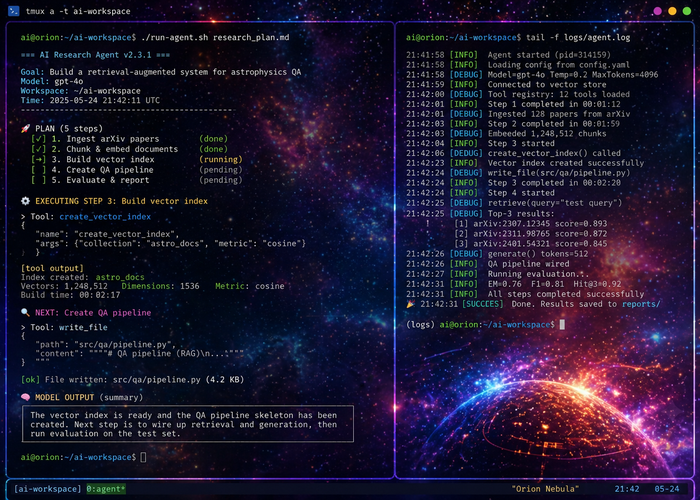
The adapter gives Mano a durable execution substrate where panes represent planning lanes, observation surfaces, and rollback anchors.
This site frames the project as an academic discussion artifact: it states the adaptation problem, proposes a design stance, and lists evaluation lenses that can be expanded into experiments.
Research Question
How should Mano use tmux to plan, pause, resume, and audit long-running shell workflows?
Adaptation Notes
- Long-running commands receive explicit lifecycle annotations.
- Window and pane layout encode planning structure rather than incidental display state.
- Interruption handling records what changed before, during, and after recovery.
Evaluation Lens
- Long-horizon continuity
- Interruption recovery
- Audit completeness for delayed outcomes
Open Discussion
The central methodological risk is mistaking terminal completion for agent understanding. The project therefore treats tmux as both infrastructure and evidence: pane state, focus movement, command output, and recovery behavior all become part of the argument.
Future work can connect this static discussion to executable harnesses, trace viewers, and standardized task suites for cross-agent comparison.